
Finding Your Style in Midlife: How to Dress with Confidence In Perimenopause
Finding your style in midlife is harder than anyone tells you it will be.
If getting dressed has started to feel more stressful than it used to, your body has changed through perimenopause, your old style rules are no longer working, and the fashion advice you have always followed was never designed for this stage of life.
There is a moment most women describe at some point in their 40s. You stand in front of your wardrobe - full of clothes you have accumulated over years - and feel like you have nothing to wear.
Not because the wardrobe is empty, but because something has shifted.
The clothes that used to fit and feel good do not work in the same way anymore.
You do not look quite like yourself. Getting dressed has quietly become a source of stress rather than pleasure.
If this sounds familiar, it is not a style failure.
It is perimenopause - and it changes your body in ways that make your existing wardrobe and style instincts genuinely less reliable. The good news is that once you understand what has changed and why, dressing for this body becomes significantly easier.
As a Melbourne-based personal stylist, Lorna Woodcock of Styled for Life specialises in working with women navigating exactly this transition.
This article covers what perimenopause does to your body and style, why your old approach may have stopped working, and the principles that actually help.
What actually happens to your body during perimenopause - and why it affects your clothes
Perimenopause can begin as early as the late 30s and typically runs through the 40s decade. It is not a single change but a gradual hormonal shift that affects the body in several ways simultaneously.
Oestrogen decline causes the body to redistribute fat differently - particularly to the midsection. Women who previously carried weight in their hips and thighs often find it accumulating around the waist and belly instead. The waist that once defined your silhouette softens or disappears. Clothes that previously fit well around the hips now gap at the waist or pull across the middle.
Beyond the midsection, skin loses some of its elasticity. Upper arms become softer. The area around the knees changes. Breast tissue shifts.
Skin tone can change too - sometimes becoming more sallow or uneven - meaning colours that once lit up your face may no longer do the same job.
Hot flashes and temperature fluctuations change what fabrics feel comfortable to wear. A synthetic blouse that was fine at 38 may feel unbearable at 45.
None of these changes are permanent in the sense that they define who you are or how you can dress. But they do mean that the style system you were working with no longer fits your body - and needs updating.
Why finding your style in midlife requires a different approach
Most of us build a style intuition over time - the shapes that work, the brands that fit, the cuts that flatter. That intuition is built on a body that has now changed. Using the same rules on a different body produces different results.
Some of the most common style habits from earlier decades that can backfire during perimenopause:
Choosing fitted tops to look slimmer - when the midsection has changed, fitted can emphasise rather than streamline. Structure and proportion work better than tight.
Avoiding colour - many women retreat to black and navy as the body changes, but colour near the face is one of the most effective tools for looking refreshed and vibrant as skin tone shifts.
Wearing shapeless tops to cover the tummy - this often adds volume rather than concealing it. Skimming, not hiding, is the more flattering approach.
Staying with the same brands and sizes - body proportions change during perimenopause, which means sizing and fit can shift even when overall weight has not changed dramatically.
The solution is not to replace every item in your wardrobe.
It is to understand the new rules that work for the body you have now.
How to style your midlife body - 5 principles that hold
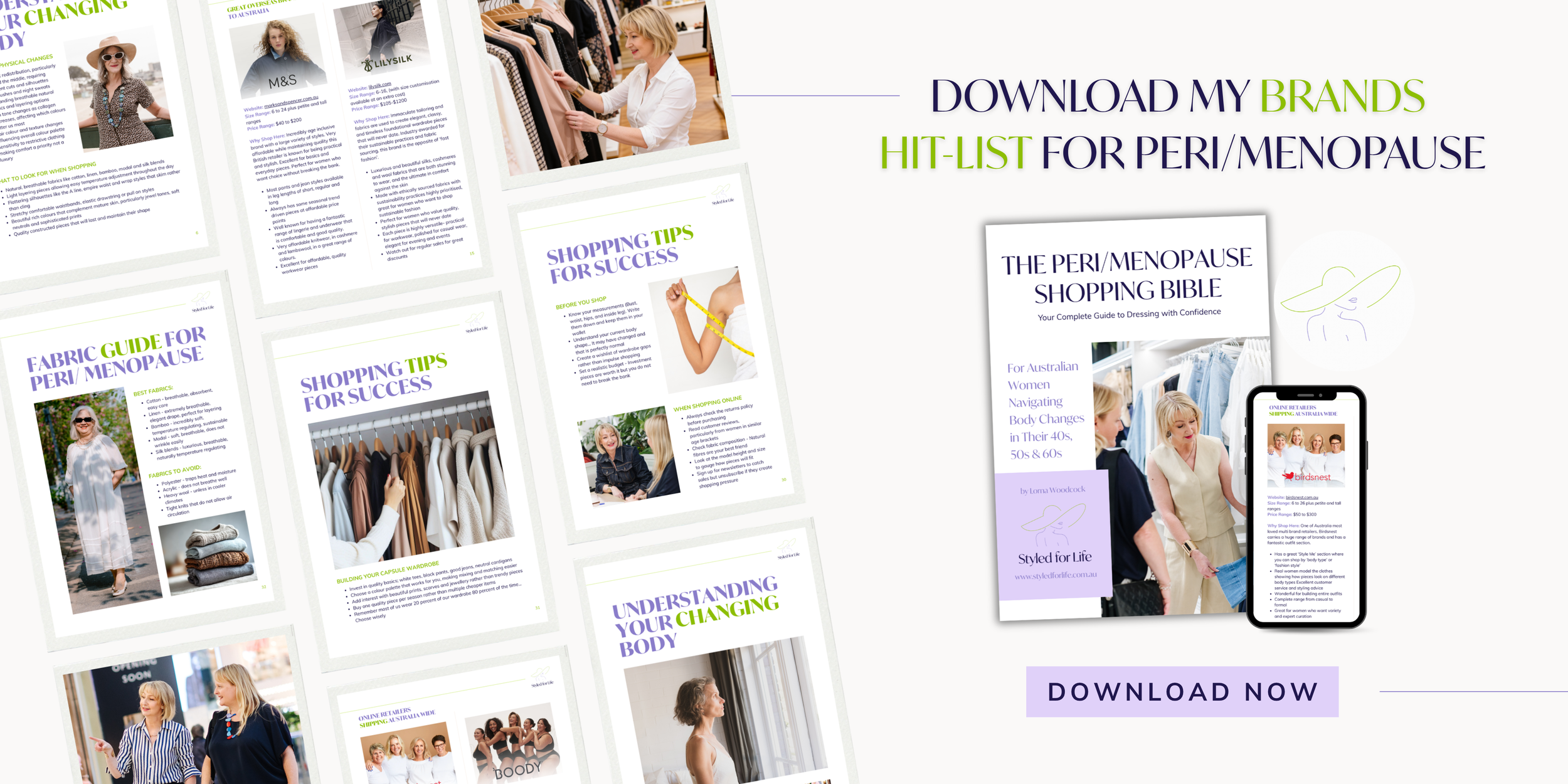
PS: Want To Know The Brands I Shop With My Styling Clients in Their 40s, 50s and 60s? Download the list HERE.
1. Proportion over size
The most flattering outfits create visual balance through proportion - not by wearing a certain size.
A wide-leg trouser balanced with a tucked-in or fitted top creates a strong silhouette regardless of the size on the label.
Think in terms of where lines fall on your body, not in terms of covering or concealing.
2. Fabric over fit
During perimenopause, fabric becomes more important than it has ever been. Natural fibres - linen, cotton, bamboo, silk - breathe and move in a way synthetics do not.
For hot flashes, lightweight layers are more useful than single heavier pieces. A cotton blazer you can remove is more practical than a structured knit you are stuck in.
3. Colour near the face
As skin tone changes during perimenopause, colour near your face becomes a powerful tool.
You may find that the shades that once suited you feel different now - some more flattering, some less.
Warm or cool-toned colours near the neckline reflect light onto the face and can make a significant difference to how fresh and vibrant you appear. This is exactly why a seasonal colour analysis is so useful at this stage of life.
4. Structure where you want it
A blazer, a structured jacket, or a firm-waisted trouser adds definition without restriction.
Structure creates shape externally, which means you are not relying on your body to do the work. A well-cut blazer over almost anything instantly creates a polished silhouette.
5. Dress for today, not for a version of yourself you are waiting to return to
This is perhaps the most important principle.
Many women in perimenopause are dressing for a body they expect to get back to - buying pieces that almost fit, holding onto clothes that fit perfectly three years ago.
Dressing for the body you have right now - with care and intention - consistently produces better results and far more confidence than waiting.
When to get help - and why a professional eye changes everything
Most women try to solve this alone. They buy more clothes hoping to find something that works. They research online. They stand in changing rooms feeling discouraged.
The challenge is that style for a changing body is genuinely complex - it requires understanding proportion, colour, fabric, and how they interact with your specific body.
That is not intuitive knowledge most of us have.
A personal stylist who specialises in this stage of life takes the guesswork out entirely. Lorna Woodcock works with women in Melbourne and virtually across Australia to build a clear picture of what works for their specific body now - not a generic formula, but a personalised approach that makes getting dressed straightforward and enjoyable again.
If you would like to explore what that looks like, download the free Perimenopause Shopping Bible below - it is a practical starting point that covers the essentials for dressing well through this transition.
Frequently asked questions
The questions below are the ones I hear most often from women navigating style changes during perimenopause.
-
Focus on principles rather than formulas; Proportion, breathable fabric, and structure work regardless of how your body fluctuates. Build a base of well-cut, flexible pieces like a wide-leg trouser, linen or cotton blazers, wrap-style tops, and add colour near your face. These principles hold even when your shape shifts week to week.
-
Perimenopause redistributes body fat (particularly to the midsection) and changes how clothes sit and drape. Clothes cut for your previous proportions will fit differently on a changed body. This is a hormonal shift, not a style failure. Updating a few key pieces to match your current shape makes a significant difference.
-
Natural breathable fabrics (linen, cotton, bamboo) for comfort through temperature changes. Structured pieces like blazers and firm-waisted trousers for shape. A-line or wrap-style dresses that skim the midsection. Layers you can add and remove. Colour near the face to refresh skin tone. These work for most women navigating this stage.
-
Skip the shapeless cover-up - it adds volume rather than concealing it. Instead: choose pieces that skim rather than cling, look for gentle structure or ruching at the midsection, pair fitted bottoms with a slightly looser top, and use a blazer or structured jacket to create a defined silhouette. Proportion is more effective than concealment.
-
For most women, yes. The challenge of dressing a changing body is that old style instincts no longer produce reliable results. A stylist who understands perimenopause can identify what specifically works for your body now, saving significant time and money compared to trial and error. Many clients describe it as the first time getting dressed felt easy again.
-
Colours that flatter your current skin tone - which may have changed from your 30s. If your skin has become more sallow or uneven, warm colours near the face (coral, warm cream, soft terracotta) can add warmth. Cooler tones suit those with pink or neutral undertones. A colour analysis identifies your specific palette precisely rather than guessing.
-
No. Start with identifying which of your existing pieces still work for your current body, then fill specific gaps with intention. Most women need 5–8 new pieces rather than a full wardrobe replacement. The key is knowing which pieces to add - which is where a personal styling session or wardrobe edit is most valuable.
Lorna Woodcock is a Melbourne-based personal stylist specialising in helping women 40+ find confidence and ease in how they dress. Services include personal shopping, wardrobe edits, style consultations, and seasonal colour analysis - available in person in Melbourne and virtually across Australia.